The World Games 2029 Karlsruhe
IWWF — International Waterski & Wakeboard Federation
DWWV — Deutscher Wasserski- und Wakeboard-Verband
IWWF — Venue Evaluation Portfolio

Waterski & Wakeboard
Venue Karlsruhe

Feasibility analysis and venue evaluation for the boat-tow waterski course and cable wakeboard facility as part of The World Games 2029 in Karlsruhe. Prepared on behalf of the German Waterski & Wakeboard Federation (DWWV) as IWWF delegate for the IWGA site inspection.

Event The World Games 2029
Dates July 19–29, 2029
Host City Karlsruhe, Germany
Disciplines Boat Tow & Cable Wakeboard
Venues Evaluated 4 Venues in the Region

Tip: For PDF, disable "Headers and footers" in the print dialog for a clean export

Key Facts at a Glance

Recommended Venue
Epplesee, Rheinstetten
35 ha water surface · 45 m max. depth · 8 km from Karlsruhe city center
Disciplines
Boat Tow + Cable
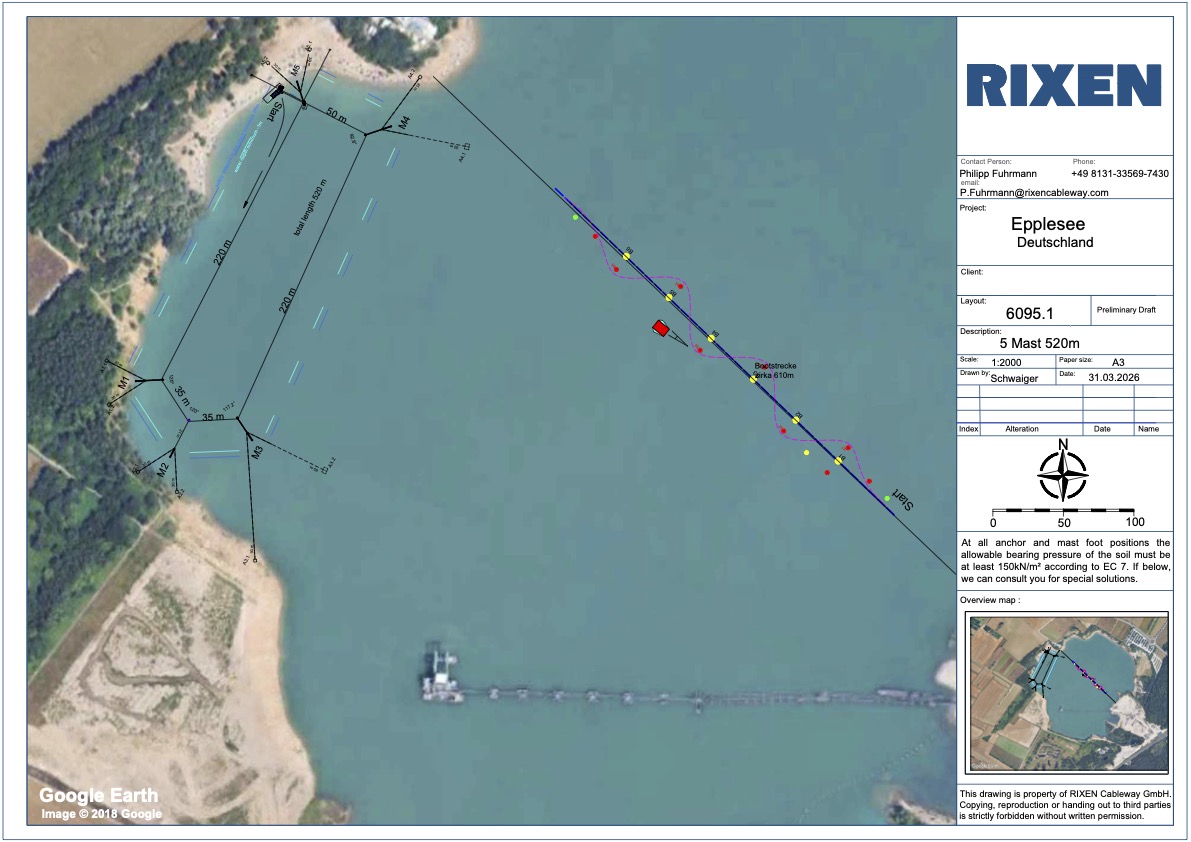
Only lake with sufficient space for simultaneous boat-tow & 5-mast Rixen cable operation
Total Investment
€850K–1.8M
Cable system, temporary infrastructure, legacy facilities · Funding target: 50–70% grants
Legacy
Permanent Cable Park
Post-Games water sports center for clubs, schools & recreational athletes in the region
Parking
1,533 Spaces
Existing automated system · complemented by shuttle from Rheinstetten tram stop
Timeline
2026–2029
Site decision Q3 2026 · Construction 2027/28 · Competition-ready Spring 2029

Summary for Decision-Makers

Epplesee in Rheinstetten is the only lake in the greater Karlsruhe area capable of hosting both an IWWF-compliant boat-tow waterski course and a 5-mast cable wakeboard system simultaneously. With 35 ha of water surface, 1,533 parking spaces, and only 8 km from the city center, the site meets the World Games 2029 core requirements for compactness and accessibility. The cable system (Rixen Cableway, global market leader) remains after the Games as a permanent water sports center — a tangible legacy project for the Karlsruhe region. The total investment is estimated at €850,000–1.8 million, with a target of 50–70% covered by public grants (federal, state, DOSB).

Economic Benefits for Karlsruhe

Waterski & Wakeboard at The World Games 2029 delivers measurable economic value to the city and region — during the event and long-term through legacy infrastructure.

15,000+
Expected Spectators
Over 5 competition days across boat-tow and cable disciplines, including athletes, officials, and media representatives
100+
Countries via Broadcast
The World Games are broadcast in over 100 countries — Karlsruhe benefits from global media exposure as a sports destination
€2–4M
Direct Economic Impact
Hotel nights, gastronomy, local transport, and tourism spending during the competition phase (est. based on TWG 2022 Birmingham)
30+ yrs
Legacy Lifespan
Permanent cable park generating annual revenue through day passes, courses, and events — a self-sustaining sports facility for the region

Brand Positioning

Karlsruhe positions itself as a modern, sport-forward city. The permanent cable park creates a unique selling point — no comparable facility exists within 150 km, attracting visitors from across Baden-Württemberg and the Rhine-Neckar region.

Youth & Community

Cable wakeboarding is one of the fastest-growing water sports in Europe. A permanent facility provides year-round programming for schools, clubs, and university sports — strengthening Karlsruhe's appeal for young residents and families.

Sustainable Tourism

The Epplesee cable park complements Karlsruhe's existing leisure infrastructure (Turmberg, Zoo, Rheinstrandbad) and creates a destination for day-trippers and weekend visitors — with minimal environmental impact through electric cable drive (30 kW).

Sustainability, Legacy & Temporary Solutions

The World Games 2029 in Karlsruhe pursue the vision of utilizing existing sports facilities and creating new infrastructure only where long-term legacy use is assured. For the boat-tow waterski course, this means: we plan the competition from the end — what remains for the region when the athletes depart?

Legacy as a Guiding Principle

The selected venue should remain usable as a permanent or seasonal water sports facility for clubs, schools, and recreational athletes after the World Games. Investments in docks, access roads, and sanitary facilities should benefit the local community long-term.

Temporary Infrastructure

Grandstands, judges' towers, ski jumps, and media areas will be planned as modular, fully removable installations. This preserves the natural character of the water body and minimizes the ecological footprint — a proven concept at international IWWF competitions.

Environmental Compatibility

Every venue is assessed for its ecological sensitivity. Nature reserves, species protection, and noise emissions from motorboats are central factors in the evaluation. We strive for a competition that respects nature rather than displacing it.

IWWF Boat Course Requirements

The International Waterski & Wakeboard Federation (IWWF) defines binding minimum requirements for boat-tow waterski competition courses. All three disciplines — Slalom, Tricks, and Jump — must be feasible on the same body of water.

Slalom Course
Approach & Run-Out Zone
Course Length
259 m
6 buoys, tolerance 1/4 %
Minimum per side
180 m
Approach + boat braking distance
Minimum Width
Minimum Depth
Course incl. safety zones
85 m
23 m course + buffer zones
Across entire course area
1.5 m
Recommended: ≥ 3 m
Total Length (All Disciplines)
Additional Area
Slalom + Tricks + Jump + Zones
> 500 m
Ideal straight waterway
Spectators, boats, warm-up
≥ 5 ha
Shoreline and water surface combined

Rixen Full Size Cable — 5-Mast System

In addition to the boat-tow course, a cable wakeboard facility is planned as an integral part of the venue. The Rixen Full Size Cable is the world standard for competition-grade cable systems — and was the official supplier at The World Games 2025 in Chengdu, providing both Full Size Cable and Straight Line systems.

Full Size Cable (5–6 Masts)

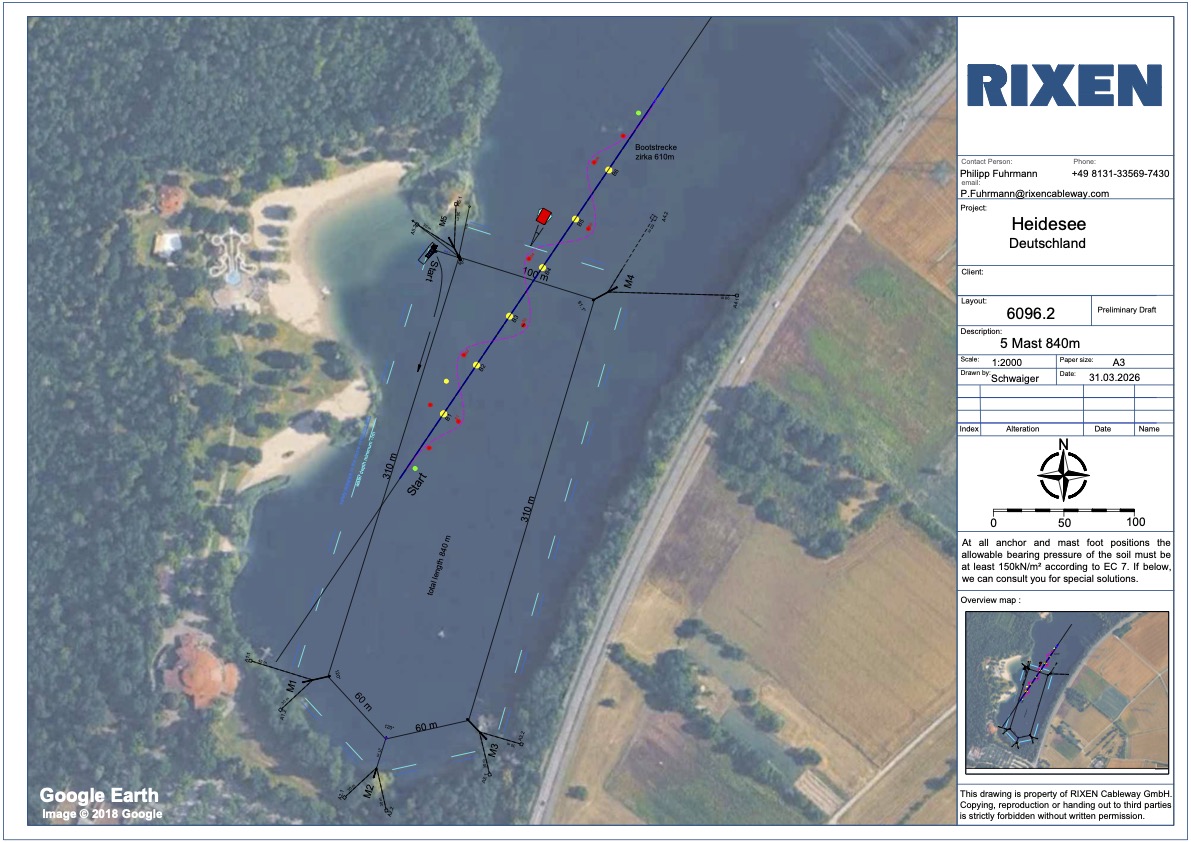
Circuit-based cableway with 5–6 towers positioned in water or on land. Riders are towed via carriers on a continuously rotating cable loop at 25–32 km/h around an approximately pentagonal course. The longest straight section between masts requires a minimum of 300 m of clear waterway.

World Games Proven

Rixen supplied both the Full Size Cable and Straight Line systems for The World Games 2025 in Chengdu (equipment value ~€410,500). Post-Games, the installation was retained as a permanent recreational center — a direct legacy model for Karlsruhe 2029.

Rapid Deployment

Complete installation in 4 weeks plus 1 week operator training. The modular system meets DIN EN 13814 safety standards and can be configured as temporary or permanent infrastructure — perfectly aligned with the WG2029 sustainability strategy.

Water Surface (Natural Lake)
Water Surface (Artificial)
Optimal dimensions
250–300 × 100–200 m
25,000–60,000 m² total area
Optimal dimensions
200–300 × 100–200 m
20,000–60,000 m² · Minimum: 90 × 160 m
Mast & Cable Height
Minimum Water Depth
Masts / Cable above water
12–14 m / 10–11 m
5 or 6 masts, in water or on land
Below cable course
1.50 m min. / 2.00 m opt.
Consistent across riding area
Safety Zone
Cable Length & Capacity
Left and right of running cable
26 m each side
52 m total clear width required
Ideal rope / max. riders
600–650 m / 8–9 riders
Up to 1,200 m · 300–500 guests/day
Drive System
Installation
Motor / daily consumption
30 kW / 100–150 kWh
~4 kW per active rider · low footprint
Full installation + training
4 + 1 weeks
DIN EN 13814 certified · modular design
✓  Cable suitability:  All three candidate lakes exceed the minimum water surface (90 × 160 m) for a Rixen Full Size Cable. The 300 m straight-line requirement is achievable at Epplesee and Heidesee; Buchtzigsee's 540 m length also accommodates the cable layout comfortably despite being too small for boat-tow.
🇨🇳

Proven at The World Games 2025 — Chengdu, China

Rixen Cableway supplied the complete cable infrastructure for TWG 2025 in Chengdu, including a Full Size Cable (5-mast) and a Straight Line (2-point) system. The installation was completed in under 5 weeks and hosted over 120 athletes from 35+ nations across wakeboard and waterski cable disciplines. Post-Games, the facility was retained by the city of Chengdu as a permanent public water sports center — the exact legacy model we propose for Karlsruhe.

Equipment Value~€410,500
Installation5 Weeks
Athletes120+ from 35 Nations
Post-GamesPermanent Legacy
SupplierRixen Cableway

Specifications: Rixen Cableway GmbH, Bergkirchen, Germany · rixencableway.com · World market leader since 1961 · 500+ installations worldwide

Regulatory & Planning Framework

Beyond technical feasibility, each venue must satisfy a complex web of German planning law, permitting requirements, and stakeholder coordination. This section outlines the key regulatory milestones that apply to all three candidate locations.

Zoning & Development Plans

F-Plan (Flächennutzungsplan / Land Use Plan): Each municipality's land use plan must designate the lake area as compatible with sports infrastructure. If the current designation is "recreation" or "agriculture," an amendment is required.

B-Plan (Bebauungsplan / Binding Development Plan): A site-specific B-Plan may be needed for permanent installations (cable masts, clubhouse). Temporary structures for the World Games may qualify for exemptions under §246 BauGB (special provisions for major sporting events).

Installation & Setup Permits

Installation Permits: Temporary grandstands, judges' towers, cable masts, and ski jumps require structural safety approvals per DIN EN 13814 and potentially a building permit from the local building authority.

Water Law Permit: Motorboat operation and cable installations in/over water bodies require permits from the Lower Water Authority at the Karlsruhe District Office (Landratsamt).

Stakeholder Involvement

Municipal Participation: The host municipality (Rheinstetten, Ettlingen, or Forst) must formally support the project through council resolution. Early engagement with the mayor's office and sports committee is essential.

Permitting Authorities: Coordinated dialogue with the Karlsruhe District Office (nature conservation, water authority, building authority) and the TWG2029 Organising Committee to streamline the approval process.

Nature Conservation Assessment

Each venue requires an ecological impact assessment covering protected species, Natura 2000 proximity, and noise emission thresholds for motorboat operation. The Lower Nature Conservation Authority must issue a formal clearance or exemption. Sites adjacent to nature reserves (NSG) face stricter scrutiny.

Existing Uses & Landowners

All three lakes serve as public bathing lakes with existing recreational users (swimmers, anglers, windsurfers, divers). Usage conflicts must be resolved through temporal zoning or compensation agreements. Landowner consent — whether municipal, private (gravel extraction companies), or state-owned — is a prerequisite for any installation.

On-Site Lifesaving & Safety

IWWF competition standards and German regulations (DIN EN 15288) require certified water rescue services on-site during all competition and training activities. Coordination with DLRG (German Lifesaving Association) or professional lifeguard services is mandatory. Medical first aid stations, ambulance access, and evacuation routes must be planned for each venue.

1
Epplesee
Rheinstetten-Forchheim · Karlsruhe District
Epplesee in Rheinstetten — panoramic view of the gravel pit lake
Photo: Ikar.us / Wikimedia Commons · CC BY 2.0 DE
Open in Google Maps
Water Surface
~35 ha
Max. Depth
45 m
Distance to KA
~8 km
Parking Spaces
1,533
Water Body Type
Gravel Pit Lake
Water Surface
9.5
Course Suitability
9.0
Accessibility
8.5
Parking Infrastructure
9.5
Public Transit
6.0
Nature Conservation
4.5
Permitting Risk
5.0
Legacy Potential
8.0
Strengths
  • Water surface & depth: Largest lake (~35 ha, 45 m deep) — exceeds all IWWF requirements for boat-tow and cable
  • Accessibility: ~8 km from Karlsruhe center; A5 motorway nearby; tram/bus to Rheinstetten then shuttle
  • Parking: 1,533 existing spaces with automated fee system (Apr–Oct, €6/day)
  • On-site infrastructure: Sanitary facilities, kiosk/beer garden, lifeguard station (seasonal), large lawn areas
  • Water sports experience: Kite, windsurf, sailing, diving already established — community understands water sports
  • Cable + Boat combined: Sufficient area to operate a 5-mast Rixen cable and boat course simultaneously
  • Temporary & permanent use: Temporary WG2029 structures on shore; cable system can remain as permanent legacy
  • Lifesaving: DLRG/lifeguard presence already established during bathing season; can be expanded for competition
Risks
  • Landowner conflict: Active gravel extraction (Heidelberger Sand & Kies GmbH) — steel cables across the lake; landowner consent and temporal coordination required
  • Nature conservation: NSG "Allmenddecker" on south shore — ecological impact assessment mandatory; motorboat noise may trigger §34 BNatSchG review
  • Zoning: F-Plan currently designates recreation/gravel extraction; B-Plan amendment or §246 BauGB exemption needed for permanent cable masts
  • Water law permit: Motorboat operation not explicitly regulated — water law permit from the Lower Water Authority (Untere Wasserbehörde) required
  • Existing uses: Conflicts with windsurfers, kitesurfers, swimmers, and FKK area during bathing season (Apr–Oct)
  • Public transit: No direct rail connection — shuttle system from Rheinstetten tram stop essential
  • Municipal approval: City of Rheinstetten council resolution required; early engagement with mayor's office recommended
Mitigation Strategies
  • Gravel extraction: Negotiate a temporal coordination agreement with Heidelberger Sand & Kies — suspend extraction during competition window (July 2029) with compensation; TWG2029 Organising Committee to mediate
  • Nature conservation (NSG): Commission ecological impact assessment in Q3 2026; propose motorboat-free buffer zones along south shore and temporal restrictions (competition only during daylight hours)
  • Zoning: Apply for §246 BauGB exemption for temporary structures (grandstands, judges' tower) — precedent exists from other major sporting events in Baden-Württemberg; permanent cable masts via simplified binding development plan amendment
  • Public transit: Establish dedicated shuttle service from Rheinstetten tram stop (S2) with 10-minute frequency during competition days; negotiate with KVV for special event routing
  • Existing users: Temporal zoning — designate competition area as exclusive-use zone during event; maintain public access to remaining lake areas; compensate affected clubs (windsurfers, kitesurfers)
✓  Boat Course:  Strongest candidate — water surface, city proximity, and infrastructure clearly favor this venue. Gravel extraction and nature conservation require early coordination.
✓  Cable System:  Ample space for a 5-mast Rixen Full Size Cable with 300 m+ straight sections. Cable and boat courses can operate simultaneously on separate areas of the lake. Strong legacy potential as a permanent cable park post-Games.

Conceptual Site Layout — Epplesee

Schematic overview of the proposed competition and infrastructure zones (not to scale)

EPPLESEE · ~35 ha IWWF BOAT COURSE (500 m+) 5-MAST CABLE COURSE GRANDSTAND MEDIA/VIP PARKING 1,533 JUDGES SANITARY N ↑ · Schematic · Not to scale
  • Boat Course: > 500 m straight waterway for Slalom, Tricks & Jump with approach/run-out zones
  • Cable Course: 5-mast Rixen Full Size Cable in pentagonal layout, separate from boat course
  • Spectator & Media: Temporary grandstands (2,000–3,000 seats), VIP area, and broadcast compound on eastern shore
  • Officials: Judges' tower, timing systems, and athlete preparation area
  • Infrastructure: Existing parking (1,533 spaces), sanitary facilities, kiosk/gastronomy, DLRG station
2
Buchtzigsee
Ettlingen-Bruchhausen · Karlsruhe District
Buchtzigsee in Ettlingen-Bruchhausen — lake view
Photo: Baden de / Wikimedia Commons · CC BY 3.0
Open in Google Maps
Water Surface
8.4 ha
Max. Depth
13 m
Lake Dimensions
540 × 180 m
Distance to KA
~12 km
Public Transit
5 min walk
Water Surface
2.5
Course Suitability
2.0
Accessibility
8.5
Public Transit
9.5
Existing Infrastructure
8.0
Nature Conservation
7.5
Permitting Risk
3.0
Legacy Potential
4.0
Strengths
  • Public transit: Best connection of all venues — Bruchhausen train station 5 min walk; bus lines with stops at 150–340 m
  • On-site infrastructure: Restaurant "Maier's Am See," sanitary facilities, kiosk, beach volleyball, basketball, playground
  • Parking: Multiple lots within 150–340 m; online ticket booking available
  • Depth: 13 m max — sufficient for both cable system and waterski at 1.5 m minimum
  • Nature conservation: Low risk — no adjacent nature reserves; lake restored in 2007 with improved water quality
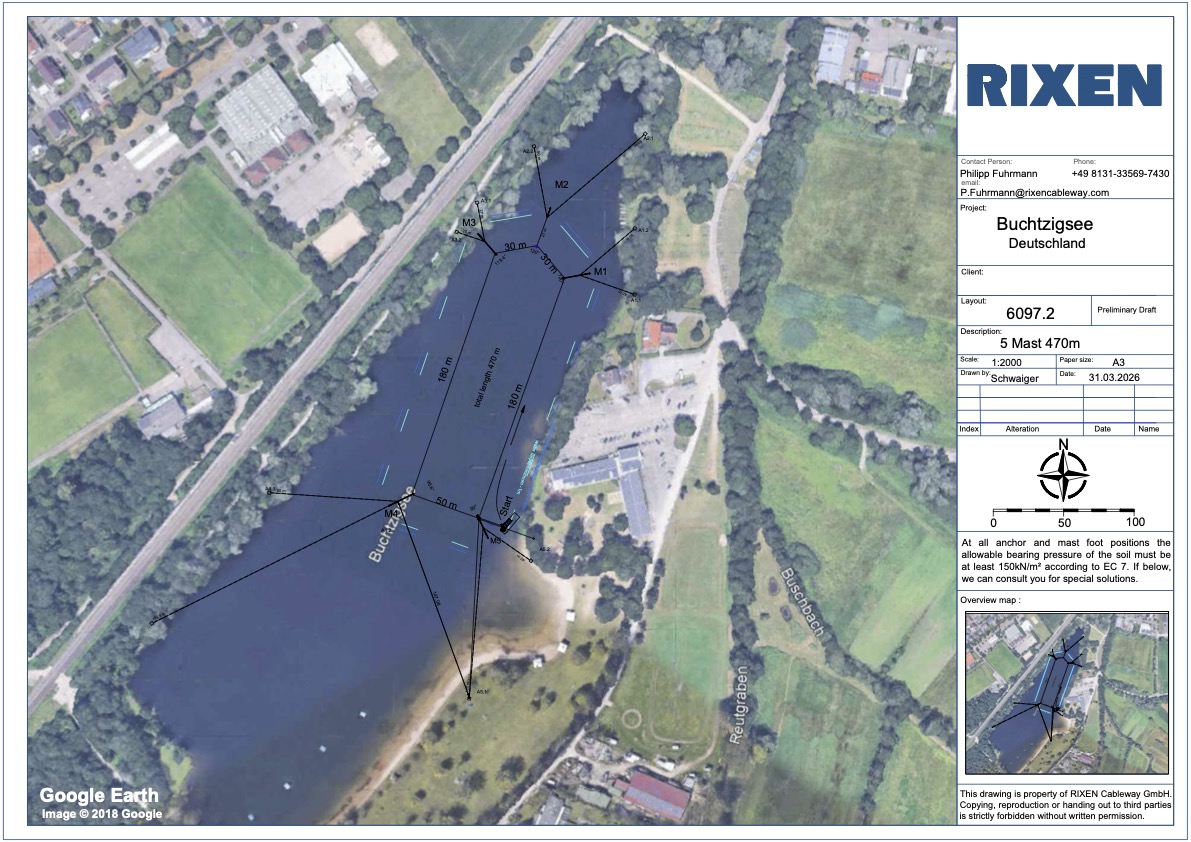
  • Cable feasibility: 540 m lake length accommodates a 5-mast Rixen cable with 300 m straight sections
  • Lifesaving: Supervised bathing area with seasonal lifeguards already in place
Risks
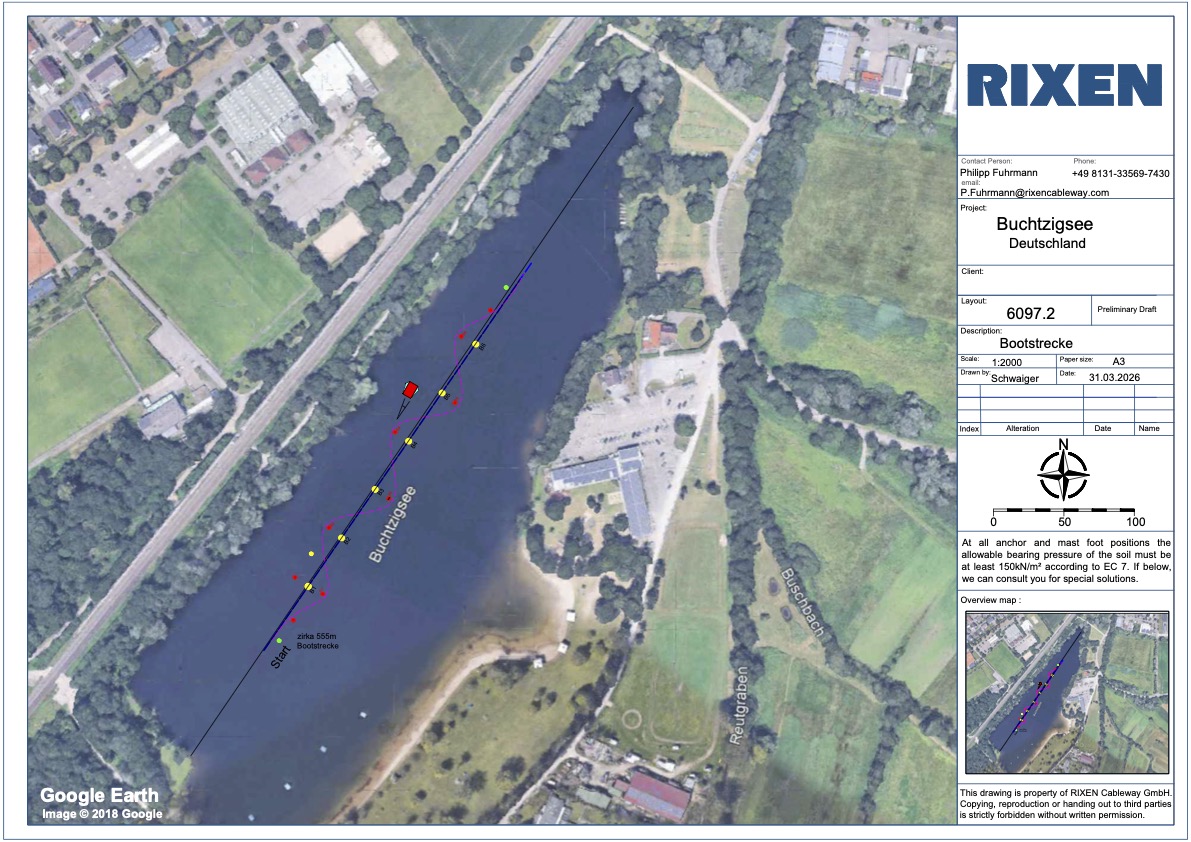
  • Critical — boat course: Lake length of 540 m falls short of IWWF minimum (≥ 620 m for slalom with approach); three boat disciplines not feasible
  • Water surface: 8.4 ha insufficient for combined cable + boat operation with safety zones
  • Existing uses: Managed by Ettlinger Bäder (municipal baths operator) — pedal boat rental, swimming, children's area; complete shutdown for competition required
  • Municipal politics: Popular public bathing lake — council resolution for temporary closure may face community resistance
  • Zoning: F-Plan designation as public recreation; permanent cable installation would require B-Plan amendment
  • Landowner: Municipally owned — consent from Ettlingen city administration required
Mitigation Strategies
  • Size limitation: Position Buchtzigsee as a dedicated cable-only venue if boat-tow is hosted at Epplesee — a split-venue concept used successfully at TWG 2017 (Wroclaw)
  • Community relations: Limit competition period to 3 days; schedule outside peak bathing season if possible; offer free public access to cable sessions post-Games as goodwill gesture
  • Municipal politics: Early engagement with Ettlingen city council and the municipal baths operator; present economic benefits (media exposure, infrastructure improvements) to offset temporary closure concerns
✗  Boat Course:  Despite excellent accessibility, the Buchtzigsee is likely unsuitable for an IWWF-compliant boat-tow waterski course due to insufficient dimensions (540 m length, 8.4 ha).
⚠  Cable System:  Suitable for a Rixen Full Size Cable (540 m length accommodates 300 m straights). However, the 8.4 ha surface limits simultaneous boat-tow and cable operation. Could serve as a dedicated cable-only venue if boat-tow is hosted elsewhere.
3
Heidesee
Forst (Baden) · Karlsruhe District
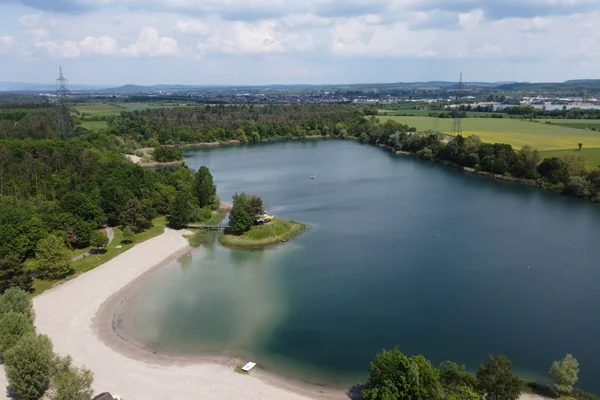
Heidesee in Forst — aerial drone view of the leisure park and bathing lake
© Markus Pfahler / seen.de
Open in Google Maps
Water Surface
~16.5 ha
Max. Depth
31 m
Distance to KA
~28 km
Shoreline Area
16 ha
Parking Fees
Free
Water Surface
6.5
Course Suitability
5.5
Accessibility (Road)
5.5
Public Transit
2.0
Spectator Areas
9.5
Nature Conservation
8.0
Permitting Risk
5.5
Legacy Potential
6.0
Strengths
  • Spectator areas: 12.5 ha lawn + 3.5 ha sandy beach — exceptional space for temporary grandstands, media, and hospitality
  • Depth: 31 m max — far exceeds all IWWF and cable system requirements
  • Noise buffer: Surrounding woodland provides natural sound insulation for motorboat operations
  • On-site infrastructure: Restaurant with beer garden, sanitary facilities, children's area, beach volleyball, table tennis
  • Event experience: Established leisure park (Freizeitpark Heidesee) with existing event management capability
  • Nature conservation: No known nature reserves in immediate vicinity; low ecological conflict risk
  • Parking: Free parking directly at entrance; A5 motorway (exit Bruchsal) provides good road access
  • Cable feasibility: Well suited for 5-mast Rixen cable; generous shoreline for mast placement
  • Permanent use: Leisure park operator open to expanding water sports offerings; strong legacy potential
Risks
  • Distance: ~28 km from Karlsruhe — contradicts the WG2029 compact venue concept; athlete/official transport logistics
  • Public transit: Bus line 125 from Bruchsal main station to "Löwen" stop only; shuttle system mandatory for competition days
  • Boat course: Exact lake dimensions (length/width) not verified — on-site survey required to confirm > 500 m straight waterway
  • Existing uses: Water slide (225 m), four recreational zones (swimmers, non-swimmers, divers, anglers) must be temporarily relocated
  • Zoning: Land use plan review and installation permit for cable masts required from the Municipality of Forst
  • Landowner: Municipally owned (Municipality of Forst) — council resolution and operator agreement needed
  • Lifesaving: No formal lifeguard service currently — DLRG deployment and medical infrastructure must be established from scratch
  • Municipal capacity: Small municipality (pop. ~8,000) — limited administrative resources for a World Games venue
Mitigation Strategies
  • Distance: Establish express shuttle from Karlsruhe Hauptbahnhof (35 min via A5); coordinate with TWG2029 transport concept for athlete and official transfers
  • Public transit: Negotiate temporary bus route extension from Bruchsal Bahnhof with enhanced frequency during competition days; explore partnership with KVV for event tickets
  • Municipal capacity: Assign TWG2029 Organising Committee project manager to support the Municipality of Forst — handle permitting, logistics, and stakeholder coordination centrally
  • Lifesaving: Contract DLRG Bruchsal/Forst for competition deployment; establish medical first aid station at existing restaurant building; coordinate ambulance access via main entrance road
⚠  Boat Course:  Solid alternative with excellent spectator areas and low nature conservation risk, but the distance to Karlsruhe and limited public transit are significant drawbacks under the WG2029 philosophy.
✓  Cable System:  Well suited for a 5-mast Rixen Full Size Cable. The 16.5 ha surface and surrounding leisure park infrastructure provide an excellent setting. The 12.5 ha lawn is ideal for spectator areas around the cable course.
4
St. Leoner See
St. Leon-Rot · Rhein-Neckar District · Existing Cable Facility · Two-Lake Complex
Aerial view of St. Leoner See recreation area — two-lake complex with water sports lake and bathing lake
© Rolf Kickuth / Wikimedia Commons · CC BY-SA 4.0
Open in Google Maps
Water Sports Lake
~16 ha
Bathing Lake
~10 ha
Max. Depth
24 m
Distance to KA
~30 km
Cable System
4-Mast (800 m)
Total Complex
~26 ha
Water Surface
6.5
Cable Infrastructure
9.5
Boat Course (Bathing Lake)
6.0
Accessibility (Road)
5.0
Public Transit
3.0
Operator Experience
9.5
Nature Conservation
7.5
Legacy Potential
9.0
Strengths
  • Two-lake complex: The facility consists of two adjacent lakes — the Water Sports Lake (~16 ha) with the existing cable system and the Bathing Lake (~10 ha) directly next to it, which could serve as a dedicated boat-tow course. This unique setup allows simultaneous cable and boat operations without interference
  • Existing cable system: Operational 4-mast cable (800 m) and 2-mast beginner lift (120 m) — no new cable installation required; upgrade to 5-mast competition standard feasible
  • Proven operator: Wasserski St. Leon has been operating the facility since 2011+ with professional staff, Pro Shop, online booking, and established customer base
  • Water sports ecosystem: Surfing, SUP, sailing, and diving already co-exist on the water sports lake — proven multi-sport usage model
  • Depth: 24 m max — exceeds all IWWF and cable system requirements
  • Safety: DLRG rescue team already present during season; dedicated diving restrictions around cable area
  • Legacy: Facility already operates commercially — no post-Games sustainability risk; competition upgrades (obstacles, timing) enhance the existing offering
  • A5 access: Directly off the A5 motorway (exit Kronau/St. Leon-Rot) — good road accessibility for athletes and equipment transport
Risks
  • Distance: ~30 km from Karlsruhe — conflicts with TWG2029 compact venue concept; similar distance challenge as Heidesee
  • Different district: Located in Rhein-Neckar-Kreis, not Karlsruhe District — cross-district coordination required with different administrative authorities
  • Boat-tow on bathing lake: Adjacent bathing lake (~10 ha) potentially suitable for boat-tow; exact dimensions for IWWF boat course (> 500 m straight waterway) require on-site survey verification
  • Public transit: Bus 719/720 connections from regional stations only; ~1h20 from Karlsruhe by public transport; shuttle system essential
  • 4-mast system: Current cable is 4-mast; upgrade to 5-mast IWWF competition standard requires investment and operator agreement
  • Existing bookings: Commercial operation with advance bookings — competition window must be negotiated to avoid revenue loss for operator
Strategy
  • Role: St. Leoner See as a fully viable fourth venue option. The two-lake complex can host both cable and boat-tow disciplines independently — serves as an alternative if Epplesee permitting encounters obstacles
  • Two-lake advantage: Cable competition on the Water Sports Lake; boat-tow slalom, tricks, and jump on the adjacent Bathing Lake — no scheduling conflicts between disciplines
  • Upgrade path: Coordinate with the existing operator for a 5th mast installation and competition-grade obstacle course; estimated additional investment €80,000–120,000
  • Operator partnership: Early engagement with Wasserski St. Leon to secure a cooperation agreement and competition window (July 2029)
✓  Cable System:  Strongest cable infrastructure of all candidates — the only venue with an existing, operational cable system. Upgrade to 5-mast competition standard is feasible with moderate investment.
⚠  Boat Course:  Adjacent bathing lake (~10 ha) is a potential boat-tow venue. Exact dimensions for IWWF-compliant course (> 500 m straight waterway) require on-site survey — to be verified during 2026 site inspection.
✓  Two-Lake Complex:  Unique advantage over all other candidates — simultaneous cable and boat-tow operations on two separate, adjacent lakes within the same facility. The only alternative venue that could potentially host all disciplines at a single site.

Timeline 2026–2029

Key milestones from site selection to competition day — aligned with the TWG2029 Organising Committee's master schedule.

2026
Site Selection & Planning
  • On-site surveys of all three lakes (Q2)
  • Ecological impact assessment (Q3)
  • Landowner negotiations — Heidelberger Sand & Kies (Q3)
  • IWGA site inspection with stakeholders (Q4)
  • Final venue decision & council resolution (Q4)
2027
Permitting & Design
  • Water law permit application (Q1)
  • F-Plan / B-Plan review with Rheinstetten (Q1–Q2)
  • §246 BauGB exemption for temporary structures (Q2)
  • Cable system engineering with Rixen (Q2–Q3)
  • Infrastructure design: docks, power, sanitary (Q3)
2028
Construction Phase
  • Cable mast foundations & installation (Q1–Q2)
  • Shore infrastructure: docks, power, drainage (Q2)
  • Test operation of cable system (Q3)
  • Coordination with gravel extraction schedule (Q3)
  • IWWF technical inspection & homologation (Q4)
2029
Competition & Legacy
  • Temporary infrastructure build-up (Apr–Jun)
  • IWWF pre-competition approval (June)
  • The World Games — Competition (July 19–29)
  • Temporary structure removal (Aug–Sep)
  • Legacy cable park grand opening (Oct)

Investment & Funding

Estimated cost breakdown for the Epplesee venue — covering both temporary competition infrastructure and permanent legacy installations.

Rixen Cable System
€350–450K
5-mast Full Size Cable incl. masts, cable, carriers, drive station, operator training · permanent installation
Shore Infrastructure
€150–300K
Docks, starting platform, power supply, drainage, lighting, accessibility improvements · partially permanent
Temporary Competition
€200–500K
Grandstands (2,000–3,000 seats), judges' tower, ski jump, timing systems, media/broadcast compound
Permitting & Planning
€50–100K
Environmental assessment, surveying, legal counsel, zoning applications, IWWF homologation
Safety & Operations
€50–150K
DLRG deployment, medical stations, security, transport coordination, volunteer management
Total Investment
€850K–1.8M
Funding target: 50–70% via DOSB, Land BW, EU sports grants, IWWF support · City co-funding for legacy infrastructure

Funding Strategy

The cable system qualifies for federal sports infrastructure grants (DOSB Goldener Plan) and Land BW sports facility funding. EU Erasmus+ Sport co-financing for cross-border water sports development may cover up to 20% of eligible costs. The TWG2029 Organising Committee covers temporary competition infrastructure.

Revenue Potential

Post-Games, the cable park generates revenue through day passes (€25–35), courses (€50–80), private events, and season memberships. Comparable facilities in Germany (e.g., Turncable Aschheim, Wasserski Langenfeld) report 15,000–30,000 visitors annually — achieving operational break-even within 2–3 years.

Comparison Matrix

All four venues in direct comparison — evaluated against the decisive criteria for an IWWF-compliant boat-tow waterski course at The World Games 2029.

Criterion Epplesee Buchtzigsee Heidesee St. Leoner See
Water Surface ~35 ha 8.4 ha ~16.5 ha ~26 ha (2 lakes)
Course Suitability (IWWF) Suitable Too Small To Be Verified To Be Verified
Maximum Depth 45 m 13 m 31 m 24 m
Distance to Karlsruhe ~8 km ~12 km ~28 km ~30 km
Public Transit Moderate Excellent Weak Weak
Parking 1,533 Available Free Available
Spectator Areas Good Limited Excellent Good
On-Site Infrastructure Moderate Excellent Good Excellent
Nature Conservation NSG South Low Risk Low Risk Low Risk
Landowner / Existing Uses Gravel Co. Active Municipal Baths Leisure Park Cable Operator
Zoning (F-Plan / B-Plan) Amendment Req. Amendment Req. Amendment Req. Existing Permit
Lifesaving / Safety DLRG Present Lifeguards Present Not Established DLRG Present
Municipal Capacity Rheinstetten Ettlingen Small (8k pop.) Diff. District
WG2029 Venue Concept City-Close City-Close Too Far Too Far
Cable System (5-Mast) Ideal Feasible Well Suited 4-Mast Existing
Boat + Cable Combined Yes No Space To Be Verified Two-Lake Split
Legacy Potential High Moderate Good Already Active

Recommendation

Based on this analysis, we recommend Epplesee in Rheinstetten as the primary venue for both the boat-tow waterski course and the 5-mast Rixen cable wakeboard facility at The World Games 2029. At ~35 ha it is the only lake with sufficient surface to host both systems simultaneously — and offers the greatest potential for a sustainable legacy as a water sports center in the Karlsruhe region. St. Leoner See (St. Leon-Rot) has been included as a fourth venue option at the request of the IWWF and IWGA, leveraging its existing 4-mast cable system, proven operator infrastructure, and adjacent bathing lake for potential boat-tow use.

Next Steps Toward Realization

To secure Epplesee as the competition venue and prepare for the IWGA site inspection, we recommend the following measures in chronological order:

  1. On-site survey of all three lakes (exact length, width, usable straight waterway) by certified surveyors
  2. Early coordination with Heidelberger Sand & Kies GmbH (landowner) regarding temporary suspension/relocation of gravel extraction during the competition phase
  3. Engagement with the Lower Nature Conservation Authority (Karlsruhe District Office) — ecological impact assessment for NSG "Allmenddecker" and motorboat noise emissions
  4. Preliminary water law inquiry with the Lower Water Authority for temporary motorboat operation and cable installation with IWWF competition status
  5. F-Plan / B-Plan review with City of Rheinstetten planning department — assess need for zoning amendment or §246 BauGB exemption for temporary and permanent structures
  6. Installation permits for temporary grandstands, judges' towers, ski jump, and cable masts — per DIN EN 13814 and local building authority
  7. Alignment with City of Rheinstetten (council resolution) and TWG2029 Organising Committee for integration into the overall venue and transport concept
  8. Coordination with Rixen Cableway GmbH for 5-mast Full Size Cable planning, site survey, and installation timeline — building on their World Games 2025 Chengdu experience
  9. On-site lifesaving and emergency services plan — coordinate with DLRG Rheinstetten, define medical stations, ambulance access routes, and evacuation procedures
  10. Creation of a legacy concept in collaboration with local water sports clubs, DWWV, and Rixen — retaining the cable system as a permanent facility post-Games (estimated total investment: €850,000–1,800,000; funding target: 50–70%)
  11. Invitation of the IWWF representative for a joint on-site inspection with all stakeholders including municipal authorities and permitting bodies

What We Need from the City of Karlsruhe

To advance the Epplesee venue from concept to reality, we respectfully request the following commitments from the City of Karlsruhe and the TWG2029 Organising Committee:

1
Political endorsement — A formal expression of support from the Mayor and City Council for hosting waterski & wakeboard at the Epplesee, including integration into the official TWG2029 venue plan
2
Permitting facilitation — Designation of a single point of contact within the city administration to coordinate zoning, water law, and nature conservation approvals across relevant authorities (District Office, Rheinstetten, Lower Water Authority)
3
Legacy co-investment — Commitment to co-fund the permanent cable park infrastructure (est. €150–250K city share) as a long-term community sports facility, complementing federal and state grants
4
Transport integration — Inclusion of the Epplesee venue in the TWG2029 transport concept: dedicated shuttle from Rheinstetten tram stop, temporary event signage on A5/B36, and spectator parking management
5
Landowner mediation — City support in negotiating with Heidelberger Sand & Kies GmbH for the temporary gravel extraction suspension and long-term coexistence agreement for the cable park
Edit mode — click any text to modify it. Changes apply to PDF export.